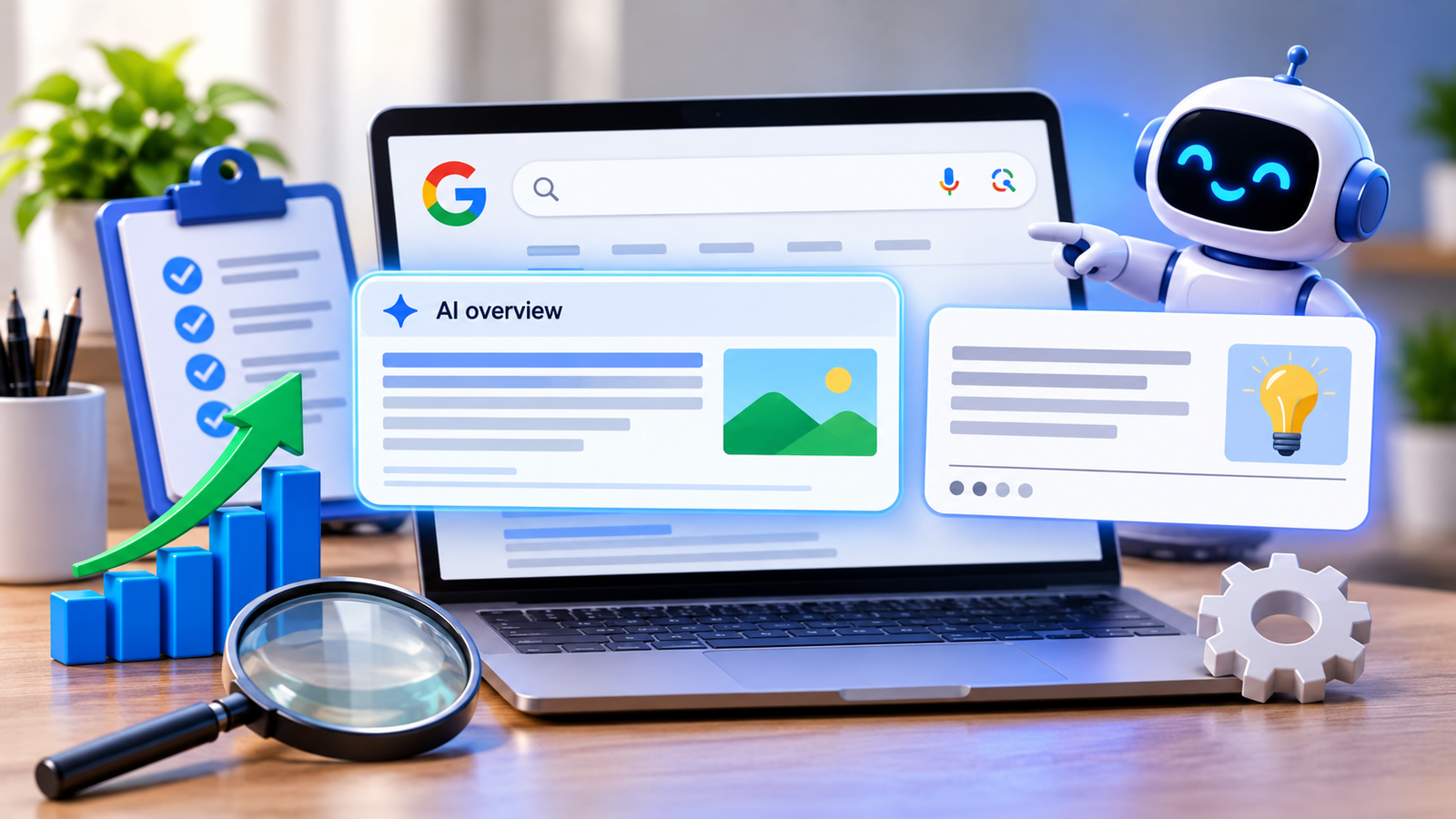
Open Google on your phone and search for almost any question. Chances are the first thing you see isn’t a blue link. It’s a neat summary written by Gemini, sitting right above everything else. That box is where a lot of your potential customers now stop reading, and it’s why Google AI Overviews optimisation has become a real line item in marketing budgets, and why many firms now look for an AI marketing agency in Gurgaon to handle it.
The scale is hard to ignore. Google said at I/O 2026 that AI Overviews now reach more than 2.5 billion people every month. Industry studies also report that organic click-through rates drop sharply on queries where an Overview appears, from around 1.76% to 0.61% in one widely cited analysis. So yes, the old playbook needs a rethink, and AI in marketing in Gurgaon is now a regular boardroom topic. But it hasn’t been thrown out.
AI Overviews Sit on Top of SEO, Not Instead of It
Here’s the part people miss. Google pulls Overview citations mostly from pages that already rank and already satisfy a search intent. If your page is thin, slow or confusing, no clever trick will fix that.
Unlike a featured snippet, which lifts text from one page, an Overview blends information from several sites. Research on Overview citations suggests it draws on five or six sources on average. That’s good news for smaller brands, because you don’t have to beat everyone. You just have to be useful enough to be one of the five.
Write the Answer First, Then the Explanation
Featured snippet optimisation and Google AI Overviews optimisation share one habit: lead with the answer. If your heading asks “How long does SEO take?”, the very next lines should say “Most websites see early movement in three to six months, though competitive keywords can take longer.” After that, you can add nuance, examples and caveats.
A few formats tend to get picked up often:
- Short paragraphs of 40 to 60 words that answer one question cleanly.
- Numbered lists for processes and steps.
- Simple tables for comparisons, like pricing tiers or tool features.
- Question-style subheadings that match how people actually type or speak.
Build an AEO Content Strategy Around Real Questions
A successful AEO content strategy starts with understanding what your audience is actually searching for. Before creating content, take time to collect genuine questions from Google’s People Also Ask section, customer conversations, sales and support calls, and Search Console queries that include terms like how, what, why, and can. These insights also help shape your AI content marketing efforts around topics that address real user needs rather than simply targeting keywords.
Once you have collected enough questions, organise them into relevant topic groups. Start with a main hub page covering the broader subject, then create supporting pages that answer individual questions in greater detail. Connect these pages through relevant internal links so search engines can better understand how the topics relate to each other. This approach makes your content more useful for readers while helping search engines identify and surface relevant answers.
Technical Signals That Help
Content gets you in the room. Structure keeps you there.
- Use schema markup. FAQ, HowTo, Article and Organisation schema help machines understand what your page is about.
- Keep headings clean. One H1, logical H2s and H3s, no skipped levels.
- Show who wrote it. Author names, short bios and a last-updated date build trust.
- Fix speed and mobile issues. A slow page rarely gets cited.
- Add original data. Even a small survey or your own case numbers gives Google something it can’t find elsewhere.
Google’s own guidance for AI features keeps coming back to the same ideas: original content, helpful structure and a good page experience. There’s no secret switch.
Measure What Actually Changes
Clicks alone won’t tell the full story anymore. Track impressions in Search Console, branded search growth, and whether your brand name shows up inside AI answers when you test your key queries by hand. Interestingly, GWI data reported by Search Engine Journal found that around half of people who use AI search daily still click through to a cited source. Being cited isn’t a consolation prize. It sends qualified traffic, which is why featured snippet optimisation still matters alongside Google AI Overviews optimisation.
Where Local Businesses Should Start
If this feels like a lot, start small, the way a good AI marketing agency in Gurgaon would. Pick your five most valuable pages. Rewrite the opening of each so it answers the main question in two or three sentences. Add a short FAQ section, mark it up with schema, and refresh the date only when you’ve genuinely updated the content. Then wait a few weeks and test again.
This is the kind of step-by-step work AI Digital Marketing Gurgaon helps local companies with. As an ai marketing agency in Gurgaon, the team audits pages for answer readiness and builds topic clusters that earn Google AI Overviews and featured snippet placements, pairing ai in marketing in Gurgaon with human judgment. If your content is solid but invisible, a focused audit is usually the fastest place to begin.
The businesses that win here won’t be the ones chasing every new feature. They’ll be the ones who keep answering real questions better than anybody else.

Digital Marketing and Search Strategy
Leader with 14+ years of experience in SEO, GEO, AEO, LLM SEO, ORM, and ASO. He has driven organic growth for leading brands like Airtel, Bluehost, Trademo, Aviva, Mahindra Insurance, and ETV Bharat, delivering 150+ projects across multiple industries and international markets.He specializes in building future-ready search strategies that strengthen brand visibility across Google and AI-powered search platforms like ChatGPT, Gemini, and Perplexity.